
Club World Cup Bookings Model Analysis
Prior to the start of the Club World Cup, I set up a model to continue predicting the total number of booking points in football games. Considering it was the end of the European season, and the MLS and Brazilian Serie A would be taking a break, it would be the only football on. The Club World Cup format had changed drastically, it was a pilot tournament, a new idea, so there was always going to be challenges associated with predictions, but I thought I’d give it a go anyway using my current model for domestic leagues as a skeleton.
In this write-up, I will evaluate how the model performed, and any lessons or improvements that can be taken for the future. It has been a while since I did one of these write-ups, but it will be similar to how I evaluated the cards code early in its development. So, lets start off with the numbers.
Overall Club World Cup Results
There were 63 games in the competition overall, with 15 knockouts and 48 group stage matches. In total, the model accurately predicted 31 winners – a 49.21% win-rate.
On the surface, that is very, very low. In fact, out of 16 competitions with 10+ matches, only the Conference League has a lower win-rate. But the data needs a bit more interrogation before completely writing off this specific project as a failure.
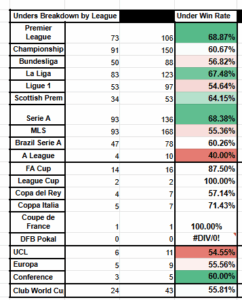
- Out of 43 unders predictions, the model managed 24 winners (55.8% win-rate)
- Out of 20 overs predictions, the model managed 7 winners (35% win-rate)
A common theme throughout this project since it started, was that unders were much more lucrative to back than overs. In fact, after 1669 tracked games, 61.2% of unders predictions have won, compared to just 49.0% of overs. Considering that bet365 lines are 110.8% accurate (they are over-predicting the number of cards by almost 11%), it’s no surprise why overs have performed so poorly. That’s exactly why I don’t stake any overs predictions, even if the model difference is large.
A 55% win-rate on unders is far from disastrous, but it’s definitely not quite as high as we would like. Here are a few comparisons for European leagues:
So, what about the actual accuracy of predictions? Maybe the cards code just got unlucky with how results went. Considering the sample size of 63 is still very small, variance can certainly play a large role, and it’s important not to get too caught up in these results.
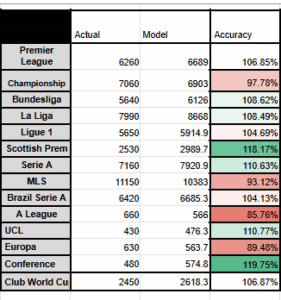
- The model predicted a total of 2618.3 booking points.
- There were 2450 bookings points actually shown
- That gives a total accuracy of 106.87% – so the model over-estimated the total number of cards, only marginally though.
Going back to the 1669 total sample, the cards code has an accuracy of 104.9%, over-estimated by a fraction short of the 5% mark. So, the cards code was slightly worse, compared to the overall average, at predicting cards at the Club World Cup, but the difference is incredibly small. Based off that, the accuracy actually seems to be quite good, and to further highlight that, here are how other European leagues rank alongside it:
- Bet365 predicted a total of 2682 cards, with an accuracy of 109.47%.
This means the cards code was more accurate than bet365, which is good. However, the difference in accuracy was much lower than usual. The cards code over-estimates by 4.9%, bet365 over-estimate by 10.8% – a difference of 5.9%. However, for the Club World Cup alone, this difference was just 2.6%.
Based off everything above, there are a few underlying reasons for the unsatisfactory win-rate during the Club World Cup:
- The cards code was slightly less accurate compared to it’s overall performance.
- Bet365 were slightly more accurate with their lines than usual.
- Small sample size of 63 introduced a fair amount of variance.
However, lets break that down even further into each round.
In order to make this data more useful, it might be worth compiling with other similar competitions – the Champions League, for example, to investigate how total number of cards changes in certain knockout rounds. In the bottom four rows, I have included data from domestic and international cup competitions from the season to bolster the sample size and hopefully try and draw some conclusions more reliably.
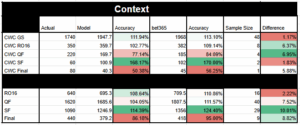
The model over-estimated the total number of cards in the group stages by 11.94%. Although that was better than bet365 (13.1% over), it’s still much higher than I would have hoped. Maybe teams are a bit more cautious to not make mistakes in these rounds.
The Round of 16 was much better, despite the obvious tiny sample size of just 8 games. The model had an accuracy of 102.77%, better better than bet365 at 109.14%.
However, the quarter-finals went quite rogue – there were a lot MORE cards shown than expected. Looking into quarter-final games for the season overall, the model has generally been very accurate, so this tournament was a real anomaly in that regard.
Similarly for the semi-final, there were a lot LESS cards shown this time, than expected. In fact, that has been a trend for the season overall – in general, bet365 tend to massively overestimate the number of cards in semi-finals, which is something to take note of for next season.
I tend to always go off the assumption that finals are cagey games, and often have low card makeups as the referee doesn’t want to be the main talking point afterwards. However, that assumption seems to be false based off the data this season. Both the model and bet365 tend to under-estimate the total number of cards shown in finals, which again is another trend to bear in mind towards the end of the season.
In conclusion, the Club World Cup might not have brought about the desired results, but there are so many lessons to be learned, which is important. The aim will be to use those lessons to improve the model, and come out with more accurate predictions for similar future competitions. I already have plenty of ideas in mind to do so.
If you would like to be a part of the group (predictions for all games are posted for free, as well as a staking plan for the high-value ones), join by clicking HERE.
I’ve got a few more articles planned over the next couple weeks, prior to the start of the new European season, so stay tuned on this website! As always, I appreciate the support on this project and will continue its’ development.